Red light camera systems: from detection to a defensible case file
A red light camera system builds a case from separate facts: the signal state, the timing, the vehicle’s position, its registration record, and the links holding those pieces together. Each has to stand up on its own, and the weakest one decides what happens when somebody contests the notice.
Procurement conversations circle around detection. The harder questions sit either side of it.
The yellow interval is part of the evidence
Start upstream of the camera. The yellow interval helps determine whether an approaching driver can stop comfortably or clear the stop line before red. A widely used kinematic approach ties its duration to approach speed, perception-reaction time, deceleration and grade, working from policy values rather than measurements of the driver in the photograph.
There is less standardisation behind those values than most people assume. In the United States, NCHRP Report 731 noted the absence of a national standard or recommended practice at the time of the research, which leaves each agency to defend its own timing. Among 267 North American respondents to the survey behind it, 60 per cent reported having no formal policy for timing change intervals.
The timing is also testable. In the better-designed studies reviewed by that research, increasing an insufficient yellow interval by about one second was associated with a 36 to 50 per cent reduction in red light running.
Automated enforcement has drawn scrutiny to exactly this question. FHWA and NHTSA guidance notes that changing the yellow time at a camera-enforced approach changes the number of recorded violations, upward when it is shortened and downward when it is lengthened. A timing change at an enforced approach therefore needs a documented engineering basis, a version history and an approval record, and the all-red interval needs the same treatment.
Detection has to establish sequence
A photograph of a vehicle sitting in an intersection proves very little. In many jurisdictions the allegation is that the vehicle crossed the stop line after the signal turned red, and the evidence design has to follow the statutory definition at the deployment site.
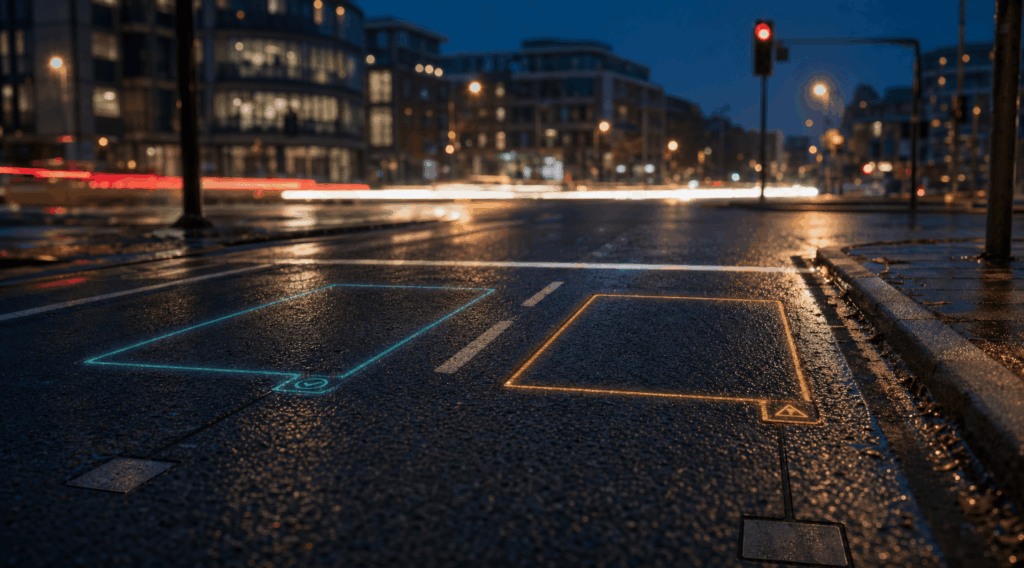
Supporting it takes four things. A validated signal-state input, obtained through an approved controller interface, electrical monitoring or an image-based method, with the record showing how that state was established. Elapsed time since red onset. Vehicle position relative to the stop line at that moment. Continuity between the first position and the second.
Position may come from inductive loops, radar, video analytics or another approved method. Some deployments combine sensors, though continuity has to come from the evidence record rather than from assumed hardware redundancy.
Two rules need explicit ownership: the enforcement threshold after red onset, and the treatment of turns permitted on red. Where the law leaves room for configuration, the authority should approve the setting and the system should retain its version history.
What the case file has to contain
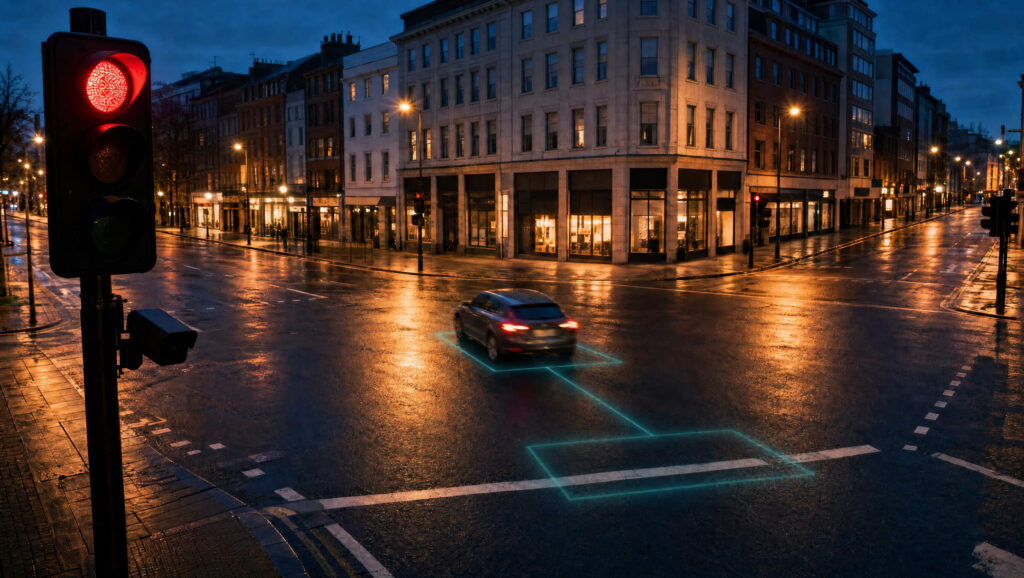
Requirements differ by jurisdiction, though the components converge. A practical baseline is two images: one at the stop line with the signal red, and one farther into the intersection. Signal phase data. Date, time and location referenced to a traceable time source. Elapsed red time, with lane and speed where recorded. A short video sequence strengthens continuity by showing the vehicle before and after the crossing.
Time synchronisation is the dull failure that quietly undoes everything above it. If the camera and signal-state records rely on unsynchronised clocks, the elapsed red value becomes hard to defend, and reconstruction may be impossible without an independent traceable time record.
Evidence integrity continues after capture. Each case needs a unique identifier, a tamper-evident link between images and event data, controlled access, and a record of every review, export and amendment. A correct image loses its value if nobody can show what happened to the file afterwards.
Plate reading supports the package without carrying it. Treat the output as any recognition result should be treated, with a documented verification step before a notice leaves the building.
Approval and the change record
Many jurisdictions subject traffic safety technology used for enforcement to type approval, calibration or periodic verification. The regime varies, so the tender should identify which approvals must be valid on the offence date and which maintenance records belong in the case file.
You also have to show that protected configuration values were not altered outside the approved process. The applicable approval establishes the accepted measurement capability, the change record shows whether the deployment stayed within its approved configuration.
Design for the contested case
Automated intersection enforcement is well established in parts of the UAE. The Ministry of Interior recorded 84,479 red light violations across the country in 2024. At AED 1,000 for a car or motorcycle, with twelve black points and a thirty-day impoundment, and AED 3,000 for a heavy vehicle, recipients have a strong reason to examine the file closely, which raises the importance of consistent review, accessible evidence and a documented dispute process.
Decide early what the recipient is legally entitled to see and what the authority will provide beyond that, who reviews a contested case, and how a withdrawal is recorded. The system also has to produce the signal timing plan version that applied at that approach on that date, whether or not the recipient receives a copy.
The test that matters
The photograph is the easy part. What decides an enforcement programme is whether the file behind each notice still holds together when somebody with a lawyer opens it months later. Ask a supplier to reconstruct one contested case end to end, using a redacted case from a live deployment or a representative acceptance-test case.
Lillyneir designs and integrates automated traffic enforcement systems for road authorities and police agencies, covering detection, signal interface, evidence packaging and case management integration. To discuss red light enforcement for your intersections, contact our team.