
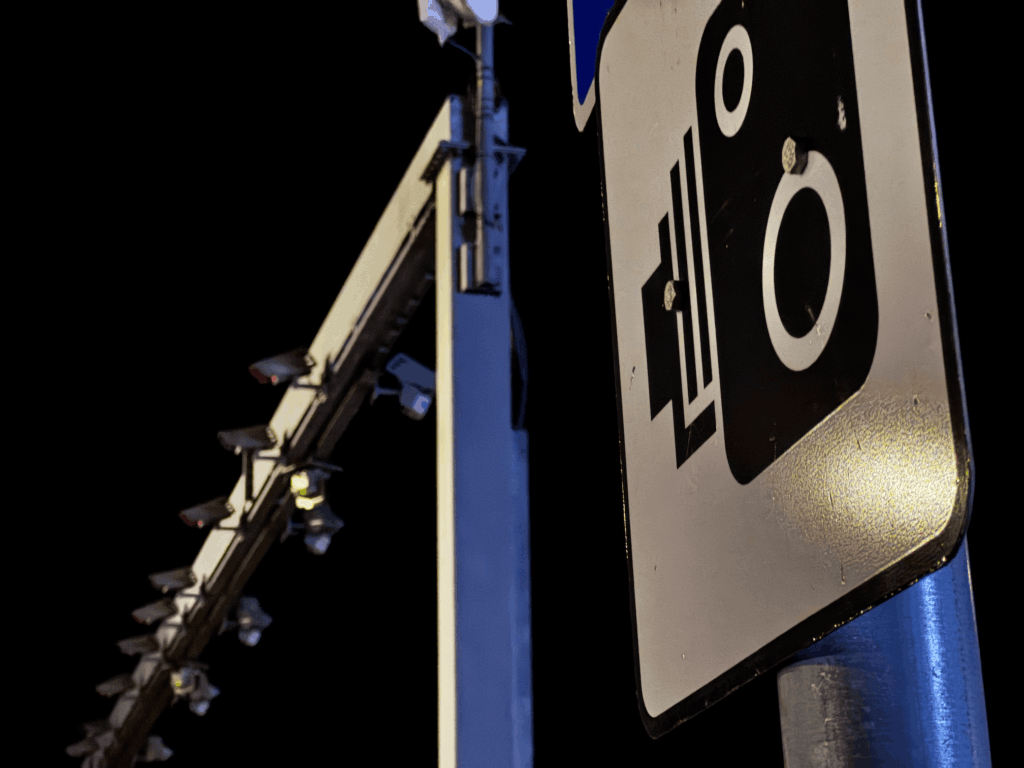
Section control turns enforcement into a two-point system
Ask most people what automated traffic enforcement systems do, and you get three answers: speeding at a fixed point, red light violations at a junction, overloaded trucks at a weighing site. All three measure at a defined location. A vehicle passes a place, a rule is checked, and an event is recorded when the threshold is met.
Average speed enforcement, usually called section control, runs on a different principle. It uses two identification points, a validated distance between them, and elapsed time. That creates a different enforcement architecture from a single-point check, with consequences for the measurement, integration and evidence chain.
Hungary’s Ministry of Transport and Investment ran a public consultation that included average speed enforcement among its questions, alongside wider use of automatic enforcement technology. The consultation closed on 9 September 2026. This article takes no position on the policy question. It looks at what the published evidence says and what the technology requires, which is where a supplier can usefully contribute.
What the published evidence says
The EU Road Safety Decision Support System synopsis reports meta-analysis results for section control and fixed speed cameras.
| Method | Injury crashes | Killed or seriously injured (KSI) crashes |
|---|---|---|
| Section control | −30% | −56% |
| Fixed speed cameras | −20% | −15% |
Individual studies add useful context. The European Commission’s average-speed-control review cites an Austrian evaluation of an 80 km/h motorway section running through a tunnel; the underlying study is Stefan and Winkelbauer’s assessment of the Kaisermühlen tunnel on Vienna’s A22. Average speed fell by more than 10 km/h in the first year. After two years, the study estimated a 33.3% reduction in injury crashes and 48.8% in fatal and serious injuries, with a cost-benefit ratio of 1:5.3. The same Commission review reports that on one enforced motorway section in the Netherlands, the proportion of speed offenders fell below 1%.
Across the studies included in the DSS synopsis, the reported effects are favourable for at least some crash outcomes. The overall direction is favourable; the precision around any single percentage is weaker. Two caveats belong with the table: the section-control injury figure combines injury crashes and crashes of unspecified severity, and the synopsis notes that the 56% KSI estimate rests on a single study while the 51% fatal-crash figure for fixed cameras may partly reflect regression to the mean.
Why the numbers get mixed up
Figures from the two techniques circulate together and get swapped, which is worth knowing when reading around the subject.
A 51% reduction in fatal crashes also appears in the synopsis, and it belongs to fixed speed cameras rather than to section control. The Austrian 48.8% covers fatal and serious injuries together, not fatalities alone. A business case built on a number separated from its technique, outcome category or study design can quickly stop meaning what its source meant.
The problem it actually solves
A fixed camera enforces the speed limit at a defined point. The DSS synopsis reports a localised effect around that enforcement location: one study found a significant reduction in injury crashes from 100 metres before the camera to one kilometre after it, while finding no significant effect from 100 metres before the camera to three kilometres after it, while finding no significant effect from 100 metres before the camera to three kilometres after it.
Section control applies the measurement across the full enforced section. The installations in the Norwegian study by Høye (2015b) cited by the synopsis ranged from 2.05 to 10.54 km. Therefore, no single measurement point can ensure compliance before speed rises again.
That mechanism should not be used to explain the numerical difference in the table by itself. The synopsis warns that treatment lengths differ, while section-control studies have mostly examined highways and motorways and fixed-camera studies have mostly examined lower-order roads.
What changes for the authority
Here, that difference becomes an integration project. A section-control system has to identify the same vehicle at two locations, establish the elapsed time between them to the required tolerance, and demonstrate that the two observations belong to the same vehicle.
Three engineering consequences follow.
Plate reading happens twice, and both reads have to hold. Recognition performance that works at one point now forms part of a two-point chain. We have written about what breaks ANPR accuracy in the field: plate population, viewing angle, character height in pixels, weather, and the distinction between a missed read and a wrong one. A section installation inherits those issues at both ends. A wrong read at either end can create a false match unless the matching and review controls catch it.
Distance and time become the measurement. The European Commission describes average speed control as calculating speed from the known distance between two camera locations and the travel time between them. Both therefore become metrological inputs. Clock synchronisation moves from housekeeping to the core of the evidence, the same shift we described for red light enforcement. Section geometry matters too: change the validated distance, and you change the basis of the calculation.
The detection and recognition chain has to support matching. Two observations become one potential case through rules of their own: matching tolerances, vehicles recorded at one end only, and journeys where a vehicle leaves the controlled section and later re-enters it.
Where the evidence chain gets tested
A contested notice can surface three recurring engineering questions.
That was not my vehicle goes to recognition performance at both points and to whether the evidence retained allows a reviewer to verify the identification.
The clocks were wrong goes to the time source, synchronisation method and the mechanism used to detect drift.
I left the section and came back goes to the matching rules and the system’s ability to distinguish a continuous transit from separate observations.
An authority that can answer those questions in writing has covered three of the main failure modes. The wider evidential case also depends on the approved measurement method, evidence integrity and the applicable legal and metrological regime.
Questions worth asking, whatever the policy outcome
Any authority evaluating section control can ask the same practical questions. What recognition performance is guaranteed at each end, under what conditions, and how is it reported? How is time synchronised between the two sites, and how would drift be detected? Who owns the matching rules, and who approves changes? What goes into a contested case file, and who assembles it? What happens to a vehicle identified at one end only?
Those questions do not decide whether to introduce section control. They determine important parts of the engineering and assurance case if it is introduced.
The crash-effect evidence cited here addresses expected safety outcomes. Technical defensibility depends on the measurement, matching and evidence-chain design behind each notice.
Lillyneir designs and integrates automated traffic enforcement systems for road authorities and police agencies, covering detection, recognition, evidence packaging and case management integration. If you are evaluating section control or another enforcement technology, we are glad to talk through what the evidence chain involves.